
Kirsten Berg:
Is an artist working in the visionary style, with a focus on painting/illustration. In 2010, she designed/created a large-scale installation, 'Constellation of One' for the Burning Man Festival in Nevada.In 2012, she designed/created 'Compound eye/I' for the Burning Man Festival. Kirsten is an authorized Ashtanga Yoga teacher based in SE Asia most of the year. She holds a BA in Classics/Latin.

❤ Kappor:
Is one of the most influential sculptors of his generation. Born in Bombay, he has lived and worked in London since the early 70's. Kapoor sees his work as being engaged with deep-rooted metaphysical polarities; presence and absence, being and non-being, place and non-place and the solid and the intangible. Throughout Kapoor's sculptures his fascination with darkness and light is apparent; the translucent quality of the resin works, the absorbent nature of the pigment, the radiant glow of alabaster and the fluid reflections of stainless steel and water. Through this interplay between form and light, Kapoor aspires to evoke sublime experiences, which address primal physical and psychological states. Anish Kapoor lives and works in London, UK

Carrie Mae Weems: Weems earned a BFA from the California Institute of the Arts, Valencia (1981), and an MFA from the University of California, San Diego (1984), continuing her studies in the Graduate Program in Folklore at the University of California, Berkeley (1984–87). With the pitch and timbre of an accomplished storyteller, Weems uses colloquial forms—jokes, songs, rebukes—in photographic series that scrutinize subjectivity and expose pernicious stereotypes. Weems’s vibrant explorations of photography, video, and verse breathe new life into traditional narrative forms: social documentary, tableaux, self-portrait, and oral history. Eliciting epic contexts from individually framed moments, Weems debunks racist and sexist labels, examines the relationship between power and aesthetics, and uses personal biography to articulate broader truths.

Sojung Kwon:
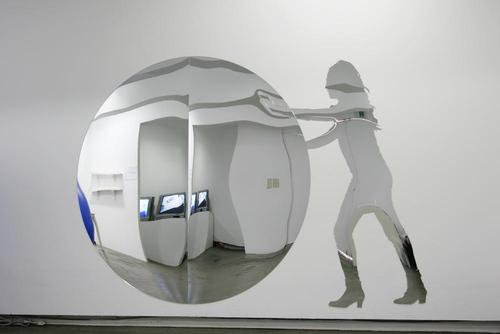
Is an artist from Seoul, Korea and currently working in the Los Angeles area. She received her BFA and MFA from Sungshin Women’s University, Seoul in 2002, and also she obtained her Masters’ degree in fine art from Otis School of Art and Design in Los Angeles, California 2007.
After she moved to Los Angeles, the different Eastern and Western public receptions of her work, and her position as an outsider in both cultures, made her want to explore the cultural, rational and linguistic discrepancy between different cultures. As a performance artist, sculptor, multi media artist, and global citizen, she uses various symbolic props and the playful banality of everyday objects to investigate social developments, social structures, and what happens when people encounter inverted social conventions. Kwon’s work explores how the normal becomes strange and the fair becomes unfair. Her work often invites the audience to participate in familiar social activities while her actions occupy spaces of non-communicative engagement.
Aleph:
Aleph consists of a matrix of car side mirrors (reclaimed factory replicas of an 1980s French model) each controlled by a network of micro-controllers. Using the spaces, people & objects it faces as a “palette” to display messages from hidden viewpoints, the vertical structure reveals an animated pixel-like graphic that reflects its surrounding environment. These pixel-like results are each captured by a series of cameras.
The name comes from a literary reference: “Aleph is a point in space that contains all other points. Anyone who gazes into it can see everything in the universe from every angle simultaneously, without distortion, overlapping or confusion.” – Jorge Luis Borges
Using sunlight to display the installation’s information illustrates the eco-friendly nature of the Aleph project; removing it from the LED world of contemporary art installation. Project creator Adam Somlai-Fischer explains:
‘The ecological element of the piece, is that it is using sunlight to display information, instead of strong LED’s used by many outdoor daylight displays. Despite the goal not being efficiency, the phenomenon used could be easily developed in that direction.’
The biggest challenge for the Aleph team was developing the mecha-tronics for positioning the mirrors with precision and speed at a low cost. Several technologies were evaluated, such as voice coil actuators consisting of a wire loop and a permanent magnet, though solenoids were chosen as the most effective way to move the mirrors.
Read more: ALEPH Environmental Art Installation | Inhabitat - Sustainable Design Innovation, Eco Architecture, Green Building :

watch Aleph video !
McElheny draws on art history, politics, and cosmology to encode his works with information, converting beautiful objects into repositories of meaning. Creatively engaging with the history of ideas, McElheny’s work entwines fact, fantasy, and material richness. As the artist has remarked, “we animate objects through our experience of them, our understandings, misunderstandings, memories, and imaginings. Objects are containers, literally and metaphorically.”
 |
| This is my favorite piece by McElheny. |

❤ symbolizes my favorites!

No comments:
Post a Comment